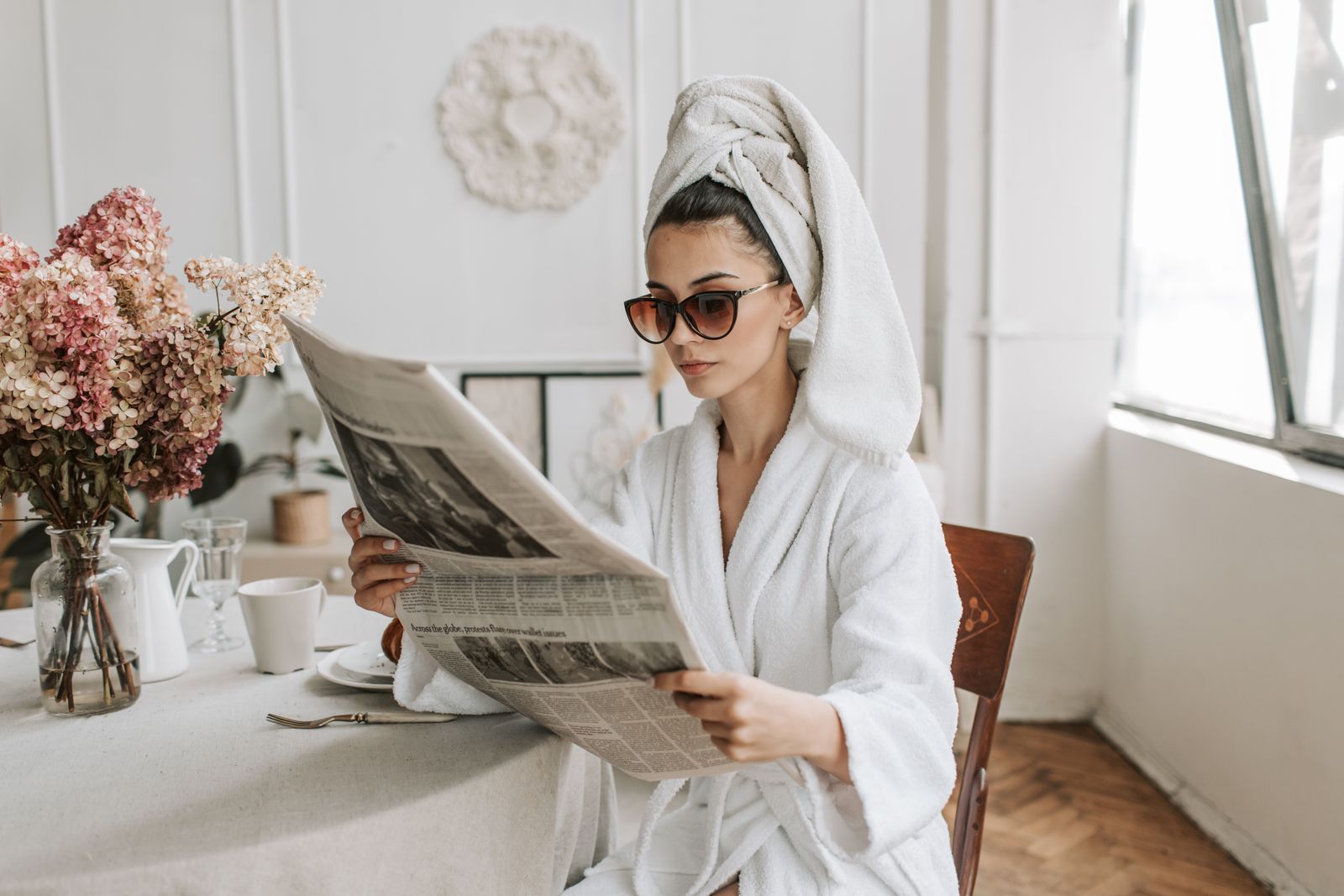
There is a woman who dresses beautifully on the days when no one will see her. A Saturday spent entirely at home; a quiet morning with nothing in the diary — and still she reaches for the silk robe, the good perfume, the gold she likes the weight of. Not to be photographed. Not to be admired. Not for any reason at all except that she prefers, even alone, to feel like herself. She is dressing for no one, which is to say she is dressing for the only person who truly matters: herself. And in an age that has turned getting dressed into a performance, this quiet, private pleasure has become almost a lost art.
We dress, now, increasingly for the eyes of others — for the photograph, the post, the approval of a room. The mirror has been replaced by the lens, and the question we ask of an outfit has subtly shifted from do I feel wonderful in this? to how will this read? It is a small change with a large cost. To dress for the camera is to dress for a flattened, public version of yourself. To dress for no one is to dress for the real one — the one who has to live inside the clothes all day, long after any audience has looked away.
The Pleasure of the Private
There is a specific, underrated joy in clothes worn purely for oneself. The cashmere put on for an evening alone. The perfume worn to do nothing in particular. The earrings kept on past the point anyone will see them, simply because you like catching them in the mirror. These are not vanities. They are small acts of self-regard — quiet declarations that your own experience of the day is worth dressing for, that you need not be observed to be worth the effort. The woman who dresses for herself has understood something the performer has not: that elegance is, first and last, a private relationship between a woman and the way she wishes to feel.
This is the philosophy beneath everything we believe about clothes at ESVRA — the same instinct that runs through the case for owning less. The considered wardrobe is not built for an audience. It is built for the life of the woman who owns it — her comfort, her pleasure, her sense of being most herself. The pieces we return to again and again are rarely the ones that photographed best. They are the ones that felt best to live in. Style, properly understood, is not how you appear to others. It is how you feel when no one is keeping score.
To dress for no one is to dress for the only person who truly matters — the one who has to live inside the clothes all day.
The Tyranny of the Audience
There is a freedom in letting go of the audience, and it is worth reaching for. The woman who dresses for the room is forever at its mercy — adjusting, second-guessing, dressing defensively against imagined judgement. The woman who dresses for herself is free of all of it. She wears the colour she loves even if it is not flattering by some external rule. She keeps the old coat that no longer impresses anyone because it still makes her happy. She is not chasing the approval of a glance, and so she cannot lose it. Her style is stable, because its source is internal — and that, not any particular garment, is what makes a woman look truly, unshakeably elegant.
It is worth saying plainly: this is also the only kind of style that lasts. Trends are made for the audience; they expire the moment the audience moves on. But the way you genuinely like to feel — the textures you reach for, the colours that please you, the shapes that make you feel most yourself — these do not expire, because they were never for anyone else. A wardrobe built on self-knowledge ages with grace. A wardrobe built on applause ages the moment the applause stops.
For Yourself, First
So dress, on the quiet days, as though the quiet days deserved it — because they do. Wear the silk to read the paper. Put on the perfume for your own company. Keep the gold on past the hour anyone will see it. Get dressed, on the mornings when no one is watching, with exactly the care you would give a great occasion — and discover that the great occasion was simply the ordinary day, lived as yourself, beautifully, for no one's pleasure but your own.
The audience will come and go. The photographs will date. But the woman in the mirror, the one you actually have to be all day — she is the one worth dressing for. She always was.
Dress for the woman in the mirror. She is the only audience that lasts.