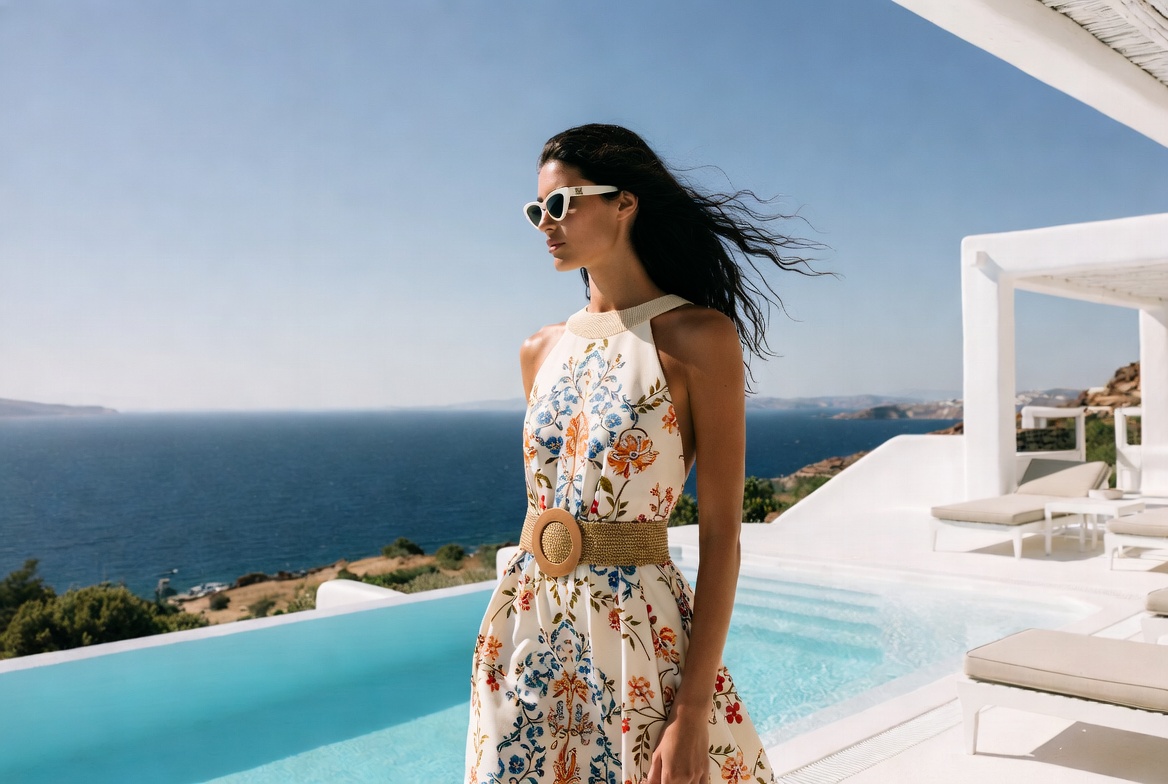
The Print Houses — a woman in a bold printed maxi dress at a luxury Mallorcan villa, ESVRA print edit
The Style Edit · Print

The Print Houses

The designers who made pattern their language — the printed dresses that walk into a room and never apologise.

Words by K.W.  ·  Editor-in-Chief
✦  From the Editor

For three long seasons we were told that taste meant beige — that the surest sign of money was a woman who could afford colour and chose to whisper instead. That era is over. The houses that never stopped painting on silk — the ones who treat a dress like a canvas and a print like a signature — have taken the room back. This is the return of the woman who wants to be seen. Not louder for the sake of it, but braver. There is nothing quiet about being unforgettable.

— K.W., Editor-in-Chief
ESVRA Editorial  /  Style
This edit contains affiliate links. If you choose to shop through them, ESVRA may earn a small commission — at no cost to you. We only ever feature what we genuinely believe is worth your attention.

Beige is not a personality. For three long seasons we were asked to believe otherwise — that the surest sign of money was a woman who could afford colour and chose, pointedly, to whisper. You know the other woman, though. She walks into the party and does not need to say a word, because she is wearing a print you will still be thinking about on the drive home: a spill of painted flowers, a paisley the colour of a Mediterranean evening, a swirl of pattern that looks less like a dress than a canvas someone lifted off a wall and wrapped around a body. Fashion spent a few years trying to convince us she was vulgar. The room never once agreed. It still belongs to her.

What we are living through now is a decisive turn away from minimalism, and the fashion press has stopped pretending otherwise. After years of quiet luxury — of Max Mara camel and The Row ivory and a general agreement that the most expensive thing a woman could wear was nothing much at all — the mood has broken. The runways of the last year told the story in colour: pattern everywhere, prints clashed on purpose, an appetite for opulence that felt almost like relief. The most modern thing you can wear now is not a beige coat. It is a dress that has an opinion.

And here is the quiet truth beneath the loud clothes: a great print is not the opposite of luxury. It is one of its oldest and most difficult expressions. To design an original print — to draw it, colour it, place it on the body so the pattern moves with her rather than fighting her — is among the hardest things a house can do. It is why the houses that do it well are so few, and why their dresses cost what they cost. This is an edit of those houses. The ones who made pattern their entire language, and never once apologised for it.

A woman in a white palm-print dress outdoors — ESVRA The Print Houses edit
The First House

The Italian Maximalists

La DoubleJ, Etro and Pucci — where the print was never a trend, but a national temperament.

To understand print as luxury, you begin in Italy — because the Italians never went quiet in the first place. This is the country that gave us Pucci's psychedelic silks in the sixties, worn by women stepping off yachts in Capri, and Etro's paisley, which turned a Persian motif into a Milanese signature. It is a lineage of dressing that treats colour as a birthright rather than a risk. The modern heir to all of it is La DoubleJ, J.J. Martin's Milan-based house, whose silk-twill dresses in clashing vintage-inspired prints have become the uniform of the woman who summers well and refuses to be forgettable doing it.

What unites the three is confidence rather than restraint. Etro drapes floral silk-chiffon into maxis that move like watercolour; Pucci keeps its swirling Orchidee prints in production because there has never been a season they looked wrong; and La DoubleJ cuts its prints into the swingy, joyful silhouettes of a woman who has somewhere glamorous to be. These are the dresses you buy once and wear for a decade — because a great Italian print does not date, it simply becomes yours.

— The Italian Edit —

La DoubleJ, Etro & Pucci

The silk-twill swing dresses, the paisley maxis and the swirling prints that started it all — Milan's answer to the beige years.

La DoubleJ Magnifico silk maxi dress  ·  La DoubleJ Swing feather-trim dress  ·  La DoubleJ silk-twill midi dress  ·  Etro draped floral silk-chiffon maxi  ·  Etro cut-out paisley satin midi  ·  Etro pleated printed cotton-poplin midi  ·  Pucci Orchidee-print silk dress

A woman in a long blue printed dress outdoors — ESVRA The Print Houses edit
A great print does not date. It simply becomes yours.— K.W., Editor-in-Chief
The New Star

The Artist's House — Alémais

The Australian house that turned a museum wall into a wardrobe.

If one name has come to define this whole return to print, it is Alémais. Founded in Sydney in 2020 by Lesleigh Jermanus — who cut her teeth designing at Zimmermann — the house was born from a single feeling: standing in front of a Cy Twombly painting and wanting to pull the canvas off the wall and wrap it around a body. That is precisely what Alémais does. Its prints are hand-drawn, often in collaboration with emerging artists, then printed on premium organic linen and finished with patchwork and embroidery you can feel with a fingertip.

The result is print as wearable art, and the fashion press has fallen for it accordingly — it is, as one editor put it, the brand behind summer's most irresistible prints. What makes Alémais the modern one is the ease. These are not stiff occasion dresses; they are linen midis and breezy shirtdresses and belted florals a woman actually lives in, joyful and grown-up at once. Buy one, and you will understand why they sell out before they reach the sale rail.

— The Alémais Edit —

Wearable Art

Hand-drawn prints on organic linen, finished with patchwork and embroidery — the dresses that made the whole print revival feel new again.

Alémais Natalia printed linen mini  ·  Alémais Dixie pleated floral cotton-poplin midi  ·  Alémais Alfie floral linen midi  ·  Alémais Lana fringed floral linen midi  ·  Alémais Nanci belted floral linen midi  ·  Alémais Dixie cotton mini

A woman in a purple silk printed dress by the pool — ESVRA The Print Houses edit
Shop the Edit

The Print Houses

Every dress in this edit, gathered in one place — the prints worth building a summer around.

A woman in a silk print dress outdoors by the pool — ESVRA The Print Houses edit
The Original

The House That Started It — Zimmermann

Before maximalism had a name, it had an Australian address.

Long before the fashion press declared quiet luxury over, Zimmermann was quietly — or rather, gloriously — doing the opposite. The Sydney house has spent two decades making sophisticated femininity its entire proposition: divine seasonal prints, romantic silhouettes, the kind of dress that turns a wedding guest into the second most photographed woman of the day. It is the original purveyor of maximalist fashion, and everything that followed owes it something.

What Zimmermann understands better than almost anyone is that a print should feel like a holiday even when you are not on one. Its Aster, Indra and Mahon dresses carry that sun-warmed ease — the sense of a woman who is entirely at home in her own glamour. If Alémais is the art-school newcomer and La DoubleJ the Milanese hostess, Zimmermann is the house you return to when you simply want to feel beautiful and be done with it.

— The Zimmermann Edit —

Sun-Warmed Romance

The seasonal prints and romantic silhouettes that defined maximalist dressing long before the rest of fashion caught up.

Zimmermann Aster printed dress  ·  Zimmermann Indra dress  ·  Zimmermann Mahon printed maxi  ·  Zimmermann Mahon printed midi

A woman in a green mini printed dress at the beach — ESVRA The Print Houses edit
A woman in a long blue printed dress seated indoors — ESVRA The Print Houses edit
The Painters

The Painterly Florals

Borgo de Nor and Cara Cara — the houses that treat a flower like a brushstroke.

There is a particular register of print that sits between the loud and the romantic — the painterly floral, where the bloom is not a motif so much as a mood. Borgo de Nor, the London house named for a Colombian family estate, does this better than most: its dresses carry lush, oil-painting florals in silk that feels custom even off the rail — the Capucine, the Freddie, the Biba, each one a small canvas.

Where Borgo de Nor is romantic, Cara Cara is its sunnier, more American cousin — the New York house whose bright, optimistic prints on cotton and linen have quietly become a warm-weather uniform for women who want print without ceremony. The Chelsea, the Alberta, the Alfie: these are the dresses of long lunches and easy travel, the ones you reach for when you want to look like summer itself.

— The Florals Edit —

Borgo de Nor & Cara Cara

Oil-painting florals in silk, and the sunnier American prints that wear like a holiday — the flower as a brushstroke.

Borgo de Nor Capucine floral dress  ·  Borgo de Nor Freddie printed dress  ·  Borgo de Nor Biba floral dress  ·  Borgo de Nor Mavaro dress  ·  Cara Cara Chelsea printed dress  ·  Cara Cara Rome dress  ·  Cara Cara Alberta linen midi  ·  Cara Cara Alfie printed dress

A woman in a brown printed midi dress outdoors — ESVRA The Print Houses edit
A woman in a blue printed mini dress by the pool — ESVRA The Print Houses edit
The Handmade

The Artisanal Hand — Agua by Agua Bendita

The Colombian house where every print is embroidered by hand.

Some prints are drawn. The most extraordinary ones are made — stitch by stitch, by hand. That is the province of Agua by Agua Bendita, the Colombian house whose dresses are elaborately embroidered by artisans, each one carrying dozens of hours of handwork. The result is print with texture and provenance — flowers you can feel, colour built up in thread rather than dye. These are heirloom pieces in the truest sense: bought for a particular summer, kept for a lifetime.

— The Artisanal Edit —

Embroidered by Hand

The Colombian house whose flowers are stitched rather than printed — texture, provenance and hours of handwork in every dress.

Agua by Agua Bendita Abeja dress  ·  Agua by Agua Bendita Consuelo dress  ·  Agua by Agua Bendita Hierbabuena dress  ·  Agua by Agua Bendita Guanguacó dress

A woman in a long green printed dress by the pool outdoors — ESVRA The Print Houses edit
A woman in a green silk long dress outdoors — ESVRA The Print Houses edit
The Everyday

The Joyful One — Farm Rio

The Brazilian house that made print an act of optimism.

Not every print needs four figures to earn its place. Farm Rio, the Brazilian house born in Rio de Janeiro, has built its entire identity on colour as joy — tropical florals, painterly fruit, prints that carry the warmth of the beach they came from. It is the most accessible house in this edit, and deliberately so: proof that a great print is a matter of spirit before it is a matter of price. A Farm Rio dress is the one you pack first and photograph most.

— The Farm Rio Edit —

Colour as Optimism

Tropical florals and painterly prints from Rio — the joyful, wear-everywhere end of the print house world.

Farm Rio floral mini dress  ·  Farm Rio Garden Terrace maxi dress  ·  Farm Rio flower mini dress  ·  Farm Rio floral midi dress

A woman in a pink silk one-shoulder dress by the pool — ESVRA The Print Houses edit

How to Wear a Statement Print

Let the dress be the whole outfit. A great print needs nothing but a bare sandal or a flat leather mule, a single piece of gold, and skin left alone. Resist the urge to add — no clashing bag, no competing jewellery, no jacket that argues. If you are nervous, begin with the print on a simpler silhouette (a column, a shirtdress) and let the pattern do the daring. And wear it with the one thing no accessory can supply: the certainty of a woman who chose to be seen.

There is nothing quiet about being unforgettable.— K.W., Editor-in-Chief
The Directory

The Houses

Nine names to know
Alémais La DoubleJ Etro Zimmermann Pucci Borgo de Nor Agua by Agua Bendita Cara Cara Farm Rio

The beige years taught us to disappear beautifully. These houses remember something better — that the most expensive thing a woman can wear is the confidence to be looked at, and the print that makes it impossible not to.

— K.W., Editor-in-Chief ESVRA