Fashion · The Tweed Trend
The New Tweed
The boxy set is finished. What replaced it is the same cloth with the starch taken out.
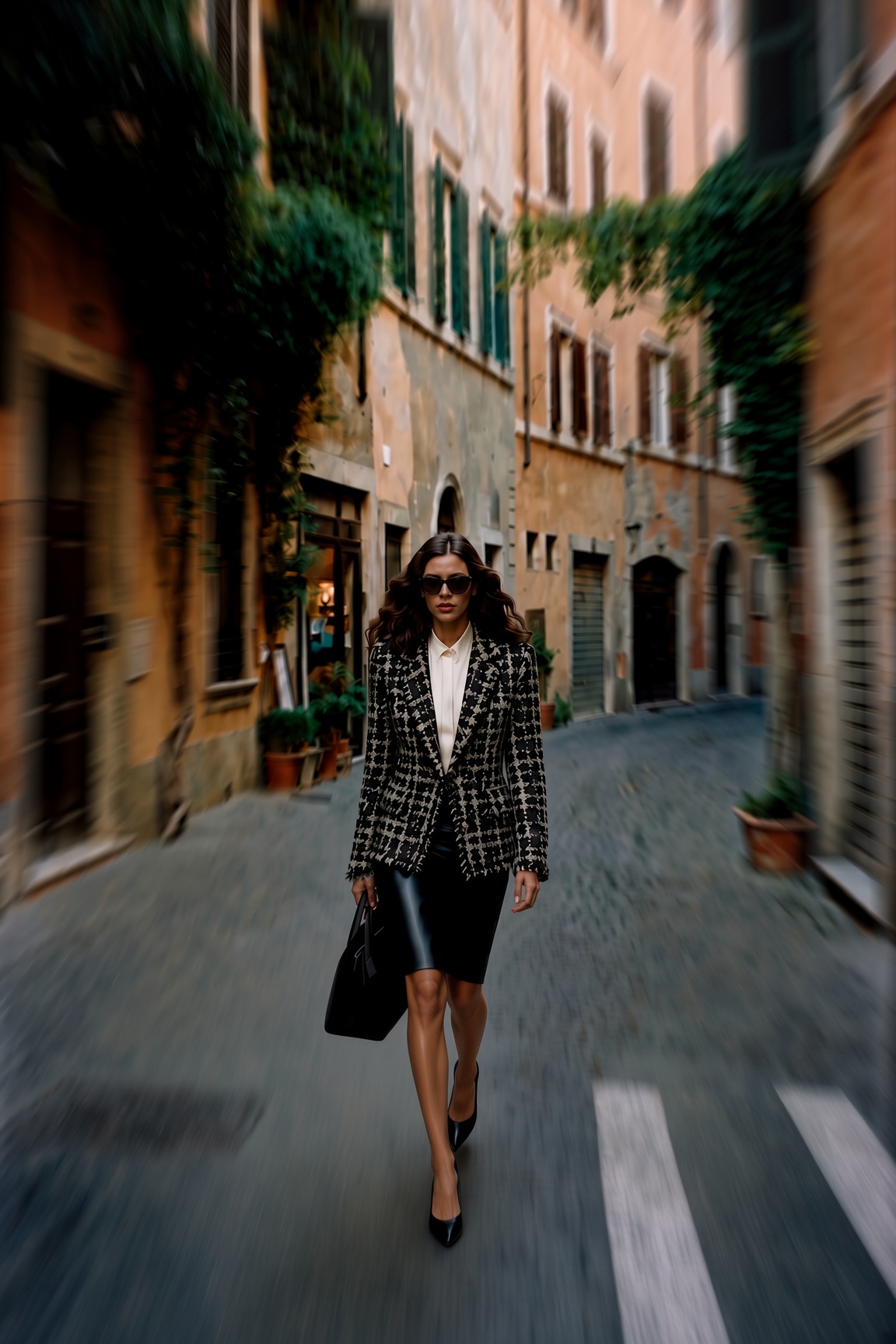
The boxy set is finished. What replaced it is the same cloth with the starch taken out.
Tweed has spent a long time being the fabric you wore to be taken seriously — stiff, boxy, buttoned, usually with a chain at the hem and a gold button at the cuff. That version is finished. What replaced it this season is the same cloth with all the starch taken out.
The two collections that made the case were run by people who had just swapped houses. Matthieu Blazy showed his second ready-to-wear for Chanel at the Grand Palais under a canopy of lacquered cranes, and rebuilt the house’s own fabric from the inside — ribbed knits, weaves threaded with lurex, silicone and gauze, metallic mesh made to mimic the traditional motif. Waists dropped. Hems came untucked. Skirts sat low and belted over bombers. He framed the whole thing on a line of Gabrielle Chanel’s: we need dresses that crawl and dresses that fly.
In Milan, Louise Trotter — who took Bottega Veneta when Blazy left it — sent eighty models across a lipstick-red carpet and made texture the entire argument. Show notes called it a dialogue between brutalism and sensuality. One coat had a bristled surface like thousands of blown-out matchsticks. A leather trench was ridged like liquorice. A single curly swing coat used more than two thousand shearling elements. Between them, the two houses turned autumn into a question about how cloth feels rather than what colour it is.
Which is where most tweed still goes wrong. The matching set is the mistake — jacket, skirt, and often a bag in the same weave, worn together, which reads as a costume of competence rather than a wardrobe. The same rule that governs check applies here: one pattern, and everything beside it plain. Tweed was never meant to be worn against itself.
The rule is one tweed piece and a different hand next to it. The jacket over leather. The skirt under a fine knit. The dress with a plain shoe and nothing textured anywhere near it. And one free detail straight off the runways at Bottega, Jil Sander and Ferragamo: leave one collar of your shirt outside the jacket. It costs nothing and it is the most current thing you can do this season.
This is not an edit for anyone dressing for a boardroom in 1994. It is for the woman who wants the cloth without the uniform — the jacket, the check, the blazer, the dress, the mini and the skirt.
Mine is the Saint Laurent single-breasted tweed jacket, worn open over leather. One tweed thing, and never the matching skirt with it.— K.W., Editor-in-Chief
The soft jacket over a leather skirt or a dark trouser. One collar out. A plain leather bag.
The tweed mini, a black heel, one gold earring. The cloth is already the decoration.
A frayed tweed skirt with a fine silk shirt. Dry against slippery is the whole trick.
The piece the season turned on — softened, unstructured, worn open. Saint Laurent, Etro, Oscar de la Renta, Chloé, Patou and Altuzarra.
The cloth is doing the work, not the trim. No chain, no gold button, nothing to date it.
Woven rather than bonded, which is why the blue has depth instead of sitting flat on the surface.
The one piece here that keeps the decoration. It works because the buttons are the only ornament on the body.
Cropped, so it sits above a high waist rather than cutting across it. Wear it with the skirt, not the trouser.
Wool-blend keeps it soft enough to fold over an arm. A jacket you can actually carry.
The house does restraint better than most. Nothing on it but the weave.
The most relaxed cut in the group. It reads as something you already own, which is the point.
The quieter price of the eight, and the easiest to wear on an ordinary Tuesday.
Where tweed stops being a suit and starts being a pattern. Saint Laurent, Erdem, Gucci and Oscar de la Renta.
The investment of the edit. Brown check in wool-blend is the version that survives every season after this one.
Cotton-blend gives it a dryness wool does not have. It hangs rather than holds.
A larger check, and a louder one. Everything under it stays plain.
The check as a whole dress rather than a jacket. One piece, done, nothing to coordinate.
Fringe at the hem is the season’s detail. It moves, which a flat tweed never does.
Tap any piece below to shop the whole edit.

The structured half of the trend — shoulder, lapel, button. Saint Laurent, Versace, Nina Ricci and Veronica Beard.
Single-breasted, so the line stays long. The most expensive thing here and the least decorated.
Bouclé with a double-breasted front is close to costume. It works because the shoulder is soft.
The most wearable double-breasted cut in the edit. Over a plain black trouser, it is the whole outfit.
The quieter price. A named house, a smaller invoice, and it does not look like either.
Tweed cut long, where the cloth has room to move. Dolce & Gabbana, Alessandra Rich and Erdem.
Silk in the blend is what stops it reading as upholstery. It falls instead of standing.
Sequins on tweed should be too much. At midi length, with a plain shoe, it is not.
The plainest dress in the edit and the one that will get the most wear.
The short version, where the cloth does all the talking. Balmain, Miu Miu and Dolce & Gabbana.
Black tweed reads as evening rather than office. A heel, one earring, nothing else.
The house cut that made the tweed mini a piece young women actually want.
Satin trim against dry tweed is the same contrast the runways worked all season, in miniature.
Lamé woven into the tweed — the fabric experiment of the season, sold as a dress.
The half of the suit worth buying on its own. Erdem, Carolina Herrera, KALLMEYER, Veronica Beard and Alessandra Rich.
Midi length keeps it out of uniform territory. With a fine knit, it is the whole look.
The pencil cut is the most severe thing you can do with tweed. It needs a soft jacket over it.
Frayed and asymmetric — the deconstructed version, and the most current shape in the edit.
The one to buy if you own nothing in tweed yet. Plain enough to wear with what you already have.
The quietest price on the page and a named house on the label.
Every piece in this edit, by the houses behind it. Explore them all.
Tweed was never the problem. The matching set was. One piece of it, something with a different hand beside it, and one collar left out.— ESVRA